Bankable recast · 8 October 2026
AURION GLOBAL HOLDINGS — and the STAR KEY power pre-feasibility
Owner-creator CEO: Wondmeneh Bekure · info@green.aurionglobalholdings.com
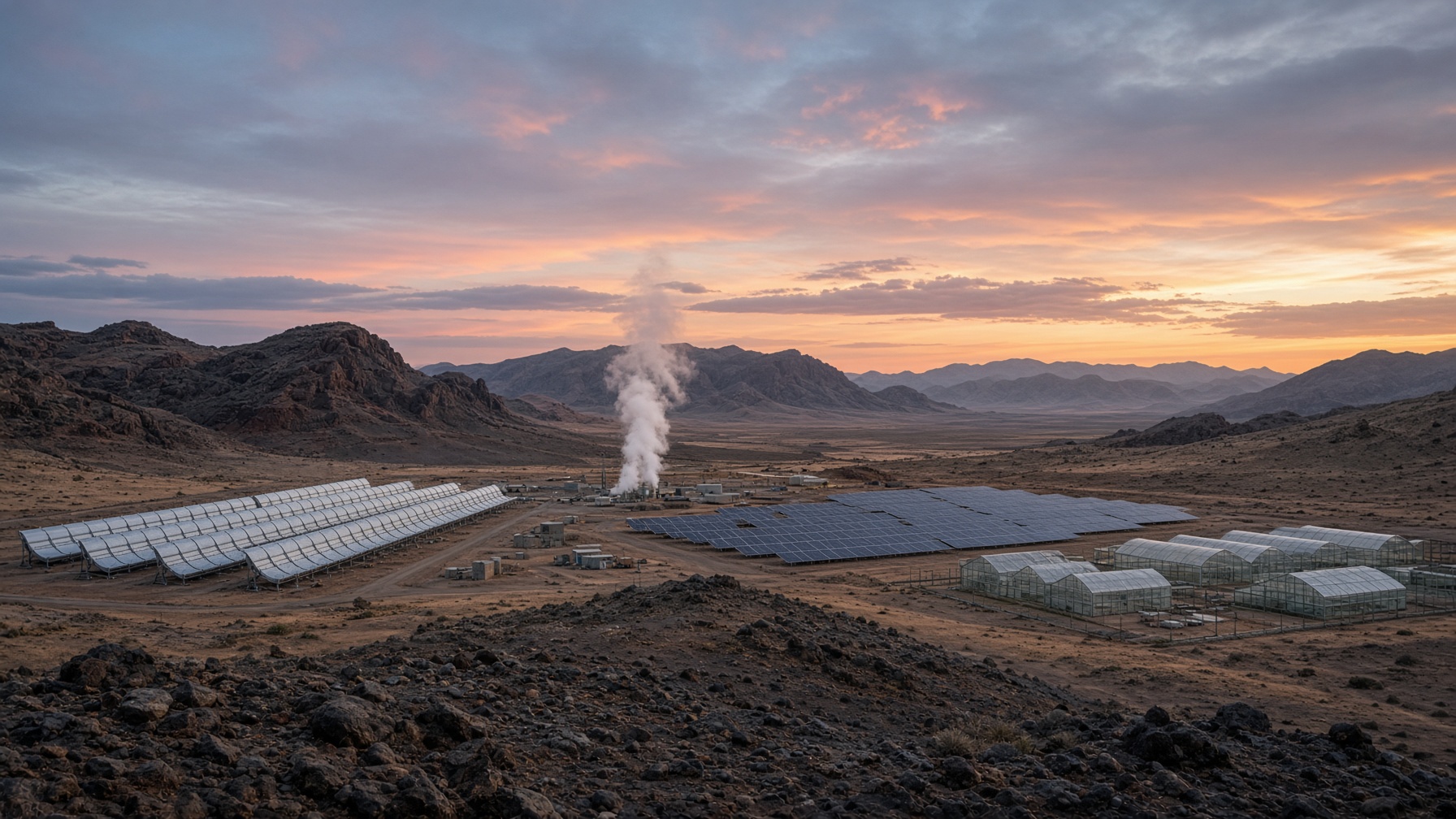
Two documents, one group. A rewritten holding plan for Markets, Jewels and Labs — and an independent pre-feasibility of the 250 MW Afar hybrid plant now sitting inside AURION POWER. Sponsor numbers are shown, then rebuilt from first principles against 2025–2026 market data.
Verdict in one page
The resource thesis is real: Afar sun is strong, Tendaho/Alalobeda has seen 220–270°C wells, Ethiopia is mid-tariff-reform, and GERD (5,150 MW, inaugurated 9 September 2025) makes drought-proof dispatchable power more valuable, not less. The financing thesis in the original pack is not. Generation is overstated by about half, the 28.7% IRR is not reproducible, Year-1 OPEX is roughly 80% light, and 200 MW / 12-hour CSP would be first-of-kind in Ethiopia.
Sponsor IRR
28.7%
As printed. Not reproduced.
Independent project IRR
500.0%
Full 250 MW, $0.085/kWh, honest CFs
Generation gap
613 GWh
1.75 TWh booked vs 1.14 TWh from stated CFs
Min DSCR (independent)
-0.16×
Min DSCR below 1.30× — lenders will not close.
Capacity mix
Project IRR — four ways of counting
What the original pack claims
| Item | Sponsor | This recast |
|---|---|---|
| Plant | 250 MW hybrid | Same nameplate; 80% is CSP |
| Annual energy | 1,752 GWh (80% CF) | 1,139 GWh from their CFs; 1,058 GWh independent |
| CAPEX | $1.860 billion | ~$1.88B restated; geo too cheap, CSP in range |
| PPA | $0.10/kWh, 20 yr, EEP | Policy PPA only; USD liquidity required |
| IRR / NPV @ 10% | 28.7% / $870M | 500.0% / −$1.59B |
| OPEX Y1 | $15M | $27M |
| Fertilizer | 40,000 t/yr | 12,000 t stretch; 4,000 t in Phase 1 |
Generation is the original sin
Capacity factors printed in the plan (CSP 50%, PV 40%, geothermal 90%) already imply 1,138,800 MWh. The cash-flow model instead books 1,752,000 MWh — exactly 80% of 250 MW × 8,760 hours. That is a geothermal-class factor applied to a solar-majority plant. Once energy is added correctly, even the sponsor CAPEX and $0.10 tariff produce a project IRR of 500.0% — before offtaker, FX and dry-hole risk.
Red-team findings
Generation math does not add up
Stated capacity factors (CSP 50%, PV 40%, geo 90%) produce 1.14 TWh/year. The plan books 1.75 TWh — an 80% blended capacity factor, which is geothermal-class performance on a plant that is 80% solar. Revenue, IRR and DSCR all sit on the inflated number.
28.7% IRR is not reproducible
Even if the $187M revenue were real, $1.86B of capital against ~$172M EBITDA is an ~9% unlevered yield, not 28.7%. The PwC “validation” language in the source pack reads as ISRS 4400 agreed-upon procedures copy, not an audit opinion, and is not independently confirmed.
Offtaker and tariff are the deal
EEP/EEU are mid-reform (16 quarterly hikes from Sep 2024; 8th landed June 2026). That does not make them a buyer of $0.10/kWh. EEU’s FY2025/26 (Addis Fortune, 9 Aug 2026) spent 133.59 billion birr against 118.91 billion of revenue. Its CEO put generation cost at 6.5–7 US cents and the selling price under 2 cents. Crypto-miner PPAs, reported at 3.2 US cents, were cut from 98% of contract to 23% in September 2026 when inflows fell. A premium USD energy price is a policy choice with a Ministry of Finance wrap, not a price the utilities clear today.
200 MW / 12-hour CSP is a first-of-continent-scale bet
Africa’s operating CSP reference (Xina Solar One) cost ~$8,950/kW for 100 MW and 5.5 h storage. Ethiopia has zero CSP operating fleet, no local trough supply chain, and no measured multi-year DNI at the site. Dry-cooled CSP in >45°C Afar will derate.
Tendaho resource is real; 20 MW is not proven
Wells have seen 220–270°C. That is a resource indicator, not a reserves statement. The 7.3 MW Aluto pilot is the country’s geothermal reference and its current availability is disputed. Corbetti and Tulu Moye — the only private geothermal PPAs of scale — were stalled as of 15 September 2026 and are renegotiating tariff, not pouring concrete. $2.50/W geothermal CAPEX omits exploration dry-hole risk and that precedent.
2,000 m³/day from 1.5–2 km basalt is not a given
Afar is hyper-arid. CSP wet cooling is inappropriate; even dry-cooled plants and 20 ha of greenhouses need water. Deep fractured-basalt yield, fluoride, silica and brine disposal must be pump-tested, not desktop-asserted. The appendix “50 billion m³ Afar storage” figure is not a cited hydrocensus result we can stand behind.
40,000 t organic fertilizer has no feedstock
A 20 ha greenhouse and a pastoral landscape do not produce 50,000 t of biomass. Organic fertilizer at that scale is a separate industrial plant. Bank the power case; treat agri as a co-product option, not 6% of revenue.
Grid is already ~90% hydro
GERD adds 15.7 TWh of hydro. Displacement of diesel/thermal can still be additional in the dry season and in Afar, but a 100 ktCO₂e/yr Verra story at $15/t is not a financing pillar. Use $5–10/t and a haircut.
Birr, convertibility, and 70%+ imported CAPEX
USD/ETB was 162.6–163.3 on 2 October 2026 (commercial mids). CBE’s cash buy that morning was 160.23; the best published cash buy was 164.88. The 2024 float already broke the tariff study’s FX assumption. CSP troughs, turbines, salt, PV modules and geo well services are FX. A 60/40 USD/ETB energy tariff without a liquidity facility is not bankable.
Year-1 OPEX is understated by ~80%
$15M on $1.86B is 0.8% of CAPEX. CSP + geothermal + desert soiling + well workovers land closer to $25–30M in year 1 before escalation.
150 ha cannot hold the plant that is drawn
Single-axis utility PV is commonly screened at about 2.2–2.8 ha per MWp, infrastructure included. A 50 MWac Phase 1 field at ~1.2 DC/AC is already on the order of the whole 150 ha parcel before wells, a greenhouse and a pastoral corridor. 200 MW of troughs does not fit beside it. The $248M case is not revised until a survey measures net buildable land.
The utility still sells power below what it says power costs
EEU FY2025/26: 133.59 billion birr spent, 118.91 billion collected, gap 14.69 billion, of which 48.42 billion was paid to EEP for bulk energy (Addis Fortune, 9 Aug 2026). The CEO’s figure: generation costs 6.5–7 US cents and is sold for under 2. A $0.085–0.10 plant is above both the stated system cost and the retail price. Reform is raising tariffs; it has not closed the gap.
September 2026 already rationed hydro — and the miners, not industry
Capital Ethiopia (20 Sep 2026) reported reservoir inflows down about 20%, miner deliveries cut from 98% of contract to 23%, and the 2026/27 export target revised to $279 million (−11%). The same report puts installed capacity at 9,752 MW and the miner tariff at 3.2 US cents. Dry years are real. They are not a reason to offtake to miners, who were cut first.
The only private geothermal PPAs are being rewritten
ThinkGeoEnergy (15 Sep 2026): Tulu Moye (Meridiam / Reykjavik Geothermal, 150 MW plan) halted litigation and is revising its PPA. Corbetti is renegotiating tariff with EEP and MoF; Taranis (Perenco) signed a convertible of up to $27 million in June 2026. Neither has confirmed a return to drilling. A Tendaho PPA signed on today’s draft will face the same reopen.
What we would take to a credit committee
Not 200 MW of CSP on day one. A three-year Phase 1 that drills Tendaho to a reserves standard, builds 50 MW of PV into a measured DNI/GHI year, interconnects at Semera, and runs 5 ha of geothermal greenhouses as a living lab. That package is on the order of $250M, with a model project IRR of 500.0% and min DSCR -0.69×. Open the live financial model to break the 250 MW case yourself.